

Seven months into 2026, here’s an overview of where the deepwater rig market is today and what’s likely to move it in the back half of the year.
Project timelines are holding. The 2H26-2027 commencement window drillers flagged in 2025 is materializing. West Africa and Southeast Asia (Eni's Kutei, Baleine Phase 3) are moving on schedule, with Namibia and Mozambique next up.
7G dayrates are improving but not yet racing back to 2024 peaks. The market is absorbing a wave of previously stranded newbuild activations, a supply dynamic that contributed to dayrate pressure in 2025.
Capital discipline still caps the oil majors' appetite, but energy security is emerging as its own demand driver. Turkey's Sakarya buildout and TPAO's 7G drillship acquisitions show what NOC-driven demand looks like without shareholders in the mix. India could be next.
The Transocean-Valaris merger remains the key item to track, ahead of Transocean's earnings call next week, where a deal status update is likely — plus a look at the antitrust case, rig mobility, and the merger's underlying rationale.
A key concern in the floating rig market 12-24 months ago was project slippage extending idle time. While modest delays persist in some cases, the 2H26-2027 commencement window drillers flagged quarters ago is generally materializing as anticipated. Nigerian multiyear projects, a past source of delays, are progressing, as are several in Southeast Asia, including Eni's Kutei Basin rich-gas project in Indonesia, which still has two rig slots to award for an expect early 2027 start. Saipem's Santorini was recently awarded Eni's Baleine Phase 3, also for early 2027 commencement.
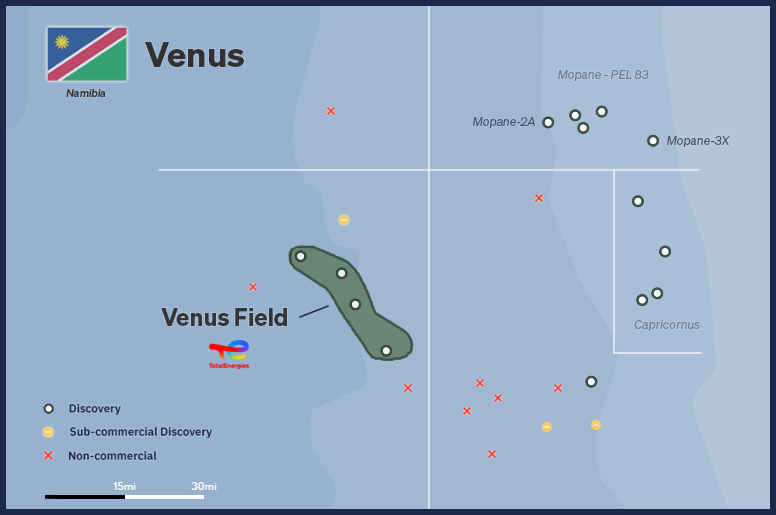
Other likely forthcoming deepwater FIDs include multiyear floater demand projects in Namibia and Mozambique, both of which are important sources of demand for 2H27 and years beyond. As of July 29th, 2026, neither of these projects have yet reached FID but TotalEnergies’ Venus (Namibia) FID is close and is anticipated to award two multiyear rig projects for work commencing late 2027.
Project commencement delays contributed to 7G utilization rates falling into the low-to-mid 80% range in late 2025 and into 2026, which contributed to 7G drillship dayrates falling from the high-$400k range to around $400k. As projects previously delayed have turned into multiyear awards, forward utilization rates on drillships have improved and biased dayrates higher. Evidencing this, Noble Viking was awarded a $460k dayrate in Brunei (2028 work) and Santorini in Cote d’Ivoire at an estimated $420-$430k level for ~18 month work commencing in early 2027.
While some contracts remain unawarded and this incorporates assumptions and estimates, it's reasonable to foresee 1H27 7G drillship utilization to average in the upper-80% range, with some months reaching the low-90s. Drillship contractors may cite higher figures, but I believe those include rigs with multiyear contracts starting later (e.g., late 2027), whereas my numbers reflect a strict working/not-working test for each individual month.
A few new multiyear African projects should benefit the drillship market, though the work has yet to be awarded and may not start until late 2027/early 2028. Rigs eventually awarded this work may have schedule gaps beforehand, leading to lower "gap filler" bids that boost utilization but contribute less to rate appreciation given their short-term nature.
7G Drillship Supply Absorption
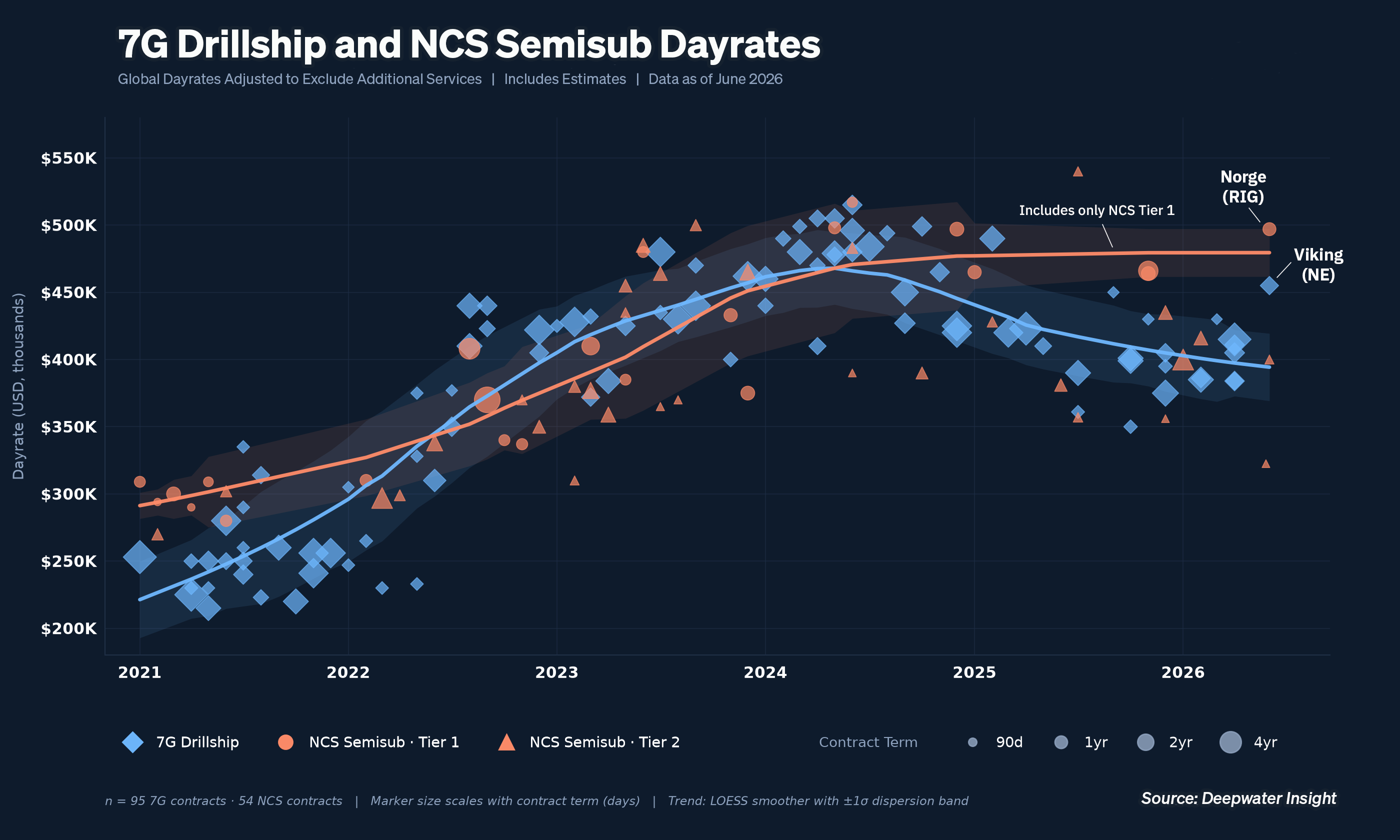
7G drillship dayrates were in the $480k-$515k range in 2024 when utilization rates averaged 95% for the year, ranging between 92% and 98% throughout the year. While the market currently is demonstrating improvement, we’re not yet at levels suggesting $500k dayrates are around the corner. Oil majors and NOCs are still investing in deepwater projects, but a key market difference today versus 2024 is the market is absorbing supply from the activation of previously stranded newbuild 7Gs: Tidal Action (Hanwha), Atlantic Zonda (Eldorado), and Deepwater Aquila (Transocean). Valaris' cold-stacked DS-7 was also reactivated.
Three of these drillships (Tidal Action, Zonda and Aquila) went into Brazil to work for Petrobras with work commencing in 2024-2025. All three of these rigs were ordered in 2013-2014, but the industry downturn left them on the sidelines for a decade. Demand growth in deepwater has supported the activation of these rigs, although the introduction of these rigs into Brazil is contributing to other rigs leaving, such as Seadrill’s West Carina recently departing Brazil and Noble’s Faye Kozack likely to follow suit when its contract ends in January 2027.
The deepwater rig market has also rationalized supply, as less efficient rigs have recently been scrapped, held for sale, or repurposed. Most lacked the specifications to compete for premium work, but their removal from the marketed fleet is still positive considering these rigs can act as marginal bids that pressure the higher-spec market.
The Norwegian Continental Shelf (NCS) semisub market remains healthy, as demonstrated in the dayrate chart, although the market has attracted new supply over the last year including the conversion of Noble’s Claus Bachmann, the forthcoming return of Transocean Barents from Romania and Transocean Endurance from Australia. This is a sign of healthy demand in Norway, although the additional supply of rigs may limit NCS semisub dayrate upside.
Oil Prices and Deepwater Rigs
Spot oil prices have been volatile due to the war in the Middle East, and oilfield services equities have traded in tandem with that volatility. Offshore drillers have become a vehicle for shorter-term traders to express views on oil prices — though for deepwater drillers, dayrates and utilization remain the primary fundamental drivers of valuation, a function of rig supply and demand rather than spot oil prices.
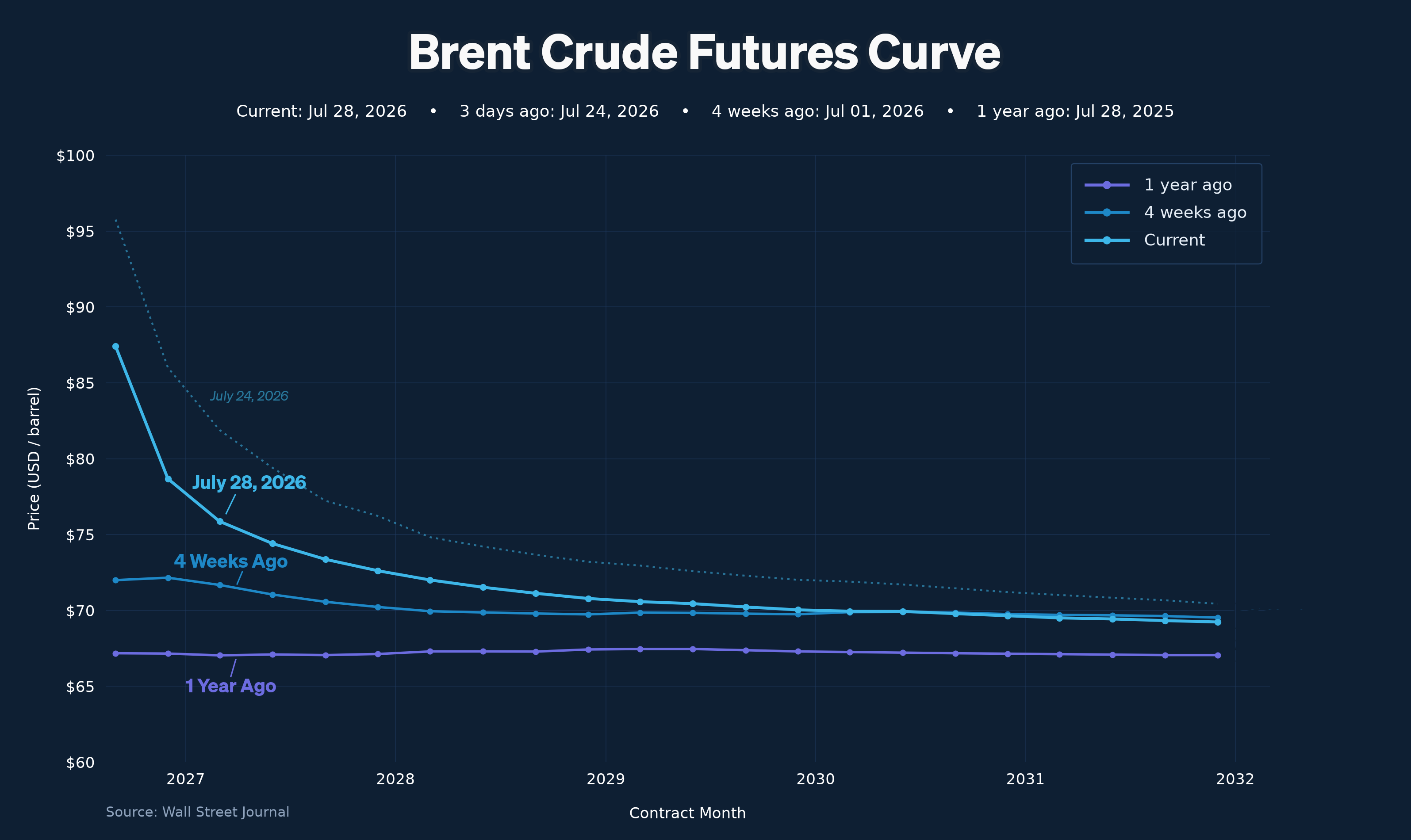
Elevated spot prices improve cash flows of customer oil majors and give them more discretionary spending power, although the investment decision to hire a rig for deepwater drilling is generally not based upon the spot price because it takes time for barrels to be produced, particularly for multiyear greenfield projects. Oil prices have been volatile and some oil majors have communicated an interest in shorter-cycle infill drilling opportunities, although given the volatile nature of the Middle East war, most oil majors appear to be remaining disciplined with capital investment and focused on longer-term projects.
Brent crude futures for 2029-2032 have generally hovered around $70/bbl, a level healthy enough for many deepwater projects still awaiting FID. The Middle East war has disrupted the spot market, and futures for that period have risen ~$3/bbl, partly on the need to replenish SPRs drawn down during recent spot weakness, which is modestly positive for deepwater although oil majors will remain capital disciplined.
While deepwater costs have come down meaningfully from 2010-2014 levels through simplified and standardized engineering designs, greenfield projects still require FPSOs — purpose-built vessels that process and store 1 to 2.5 million barrels of crude before tanker offload, typically costing $1B to $3B new. That upfront cost is significant, but it’s also why deepwater barrels get cheaper as a basin matures. Once an FPSO — with a 25-30 year economic life — is installed, future infill and tieback wells can be drilled at lower cost and shorter cycle times against existing infrastructure. The more infrastructure in place, the more low-cost brownfield options open up.
________________________
Capital Discipline vs. Energy Security
During the 2010-2013 offshore driller bull market, oil majors spent aggressively on capex with little shareholder return — 2013 capex exceeded shareholder returns by >200%. Today the split is roughly even, reflecting capital discipline: majors now prioritize investment efficiency, as shareholders demand dividends and dividend growth, a key valuation variable.
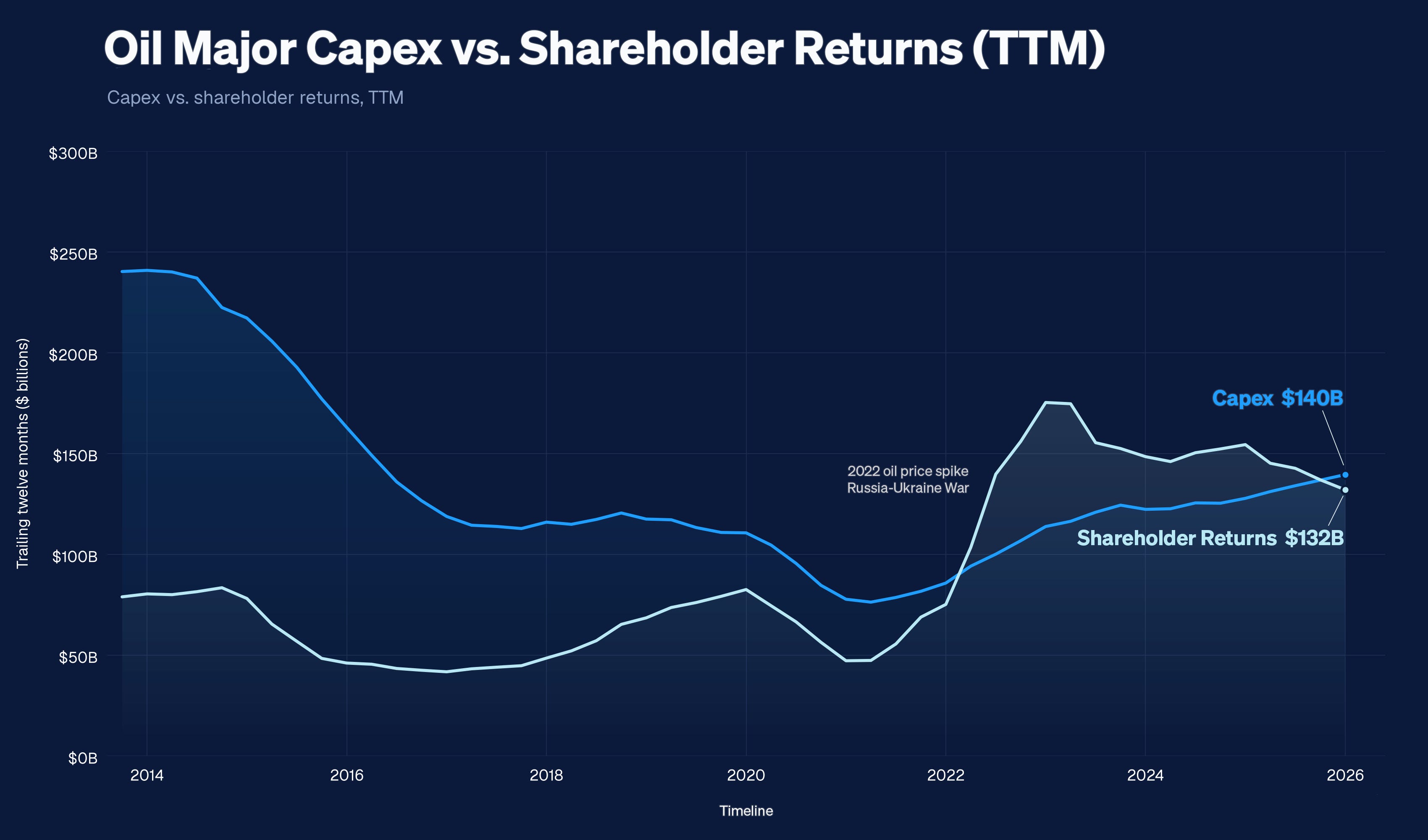
The chart shows oil majors' capex cuts since 2013-2014, though spending has crept up in recent years. Reserve life is gradually declining and exploration is modestly increasing, but capital discipline still holds, a factor suppressing drillship dayrates, all else equal.
Despite this, one of the positive things in the deepwater market is that meaningful demand is emerging from sources that are not subject to shareholders and the capital discipline doctrine. Some national oil companies have incentives to invest capital more aggressively than the majors, prioritizing energy security over the capital discipline demanded by majors' shareholders.
Turkey is arguably the best example of how the theme of energy security is positively impacting the drillship market. As Turkish Petroleum (“TPAO”) is a state-owned enterprise, its interests are tied to the government’s objectives instead of shareholders demanding dividends and share repurchases. Turkey's heavy reliance on Russian and other imported gas exposes its foreign policy to external leverage, complicating its geopolitical positioning.
Turkish Petroleum, though little-known globally, operates a six-drillship fleet. TPAO surprised the floater market in summer 2025 by acquiring Eldorado Drilling's West Dorado and West Draco, stranded newbuild drillships idling in Brunei Bay that had been awaiting activation. TPAO paid $245mm per rig plus an estimated $100mm each to activate the cold units, for an estimated all-in cost of ~$345mm apiece.
This was a key transaction for the global drillship market: had TPAO not acquired them, Dorado and Draco would likely have been marketed aggressively into outstanding multiyear tenders, negatively impacting dayrates. Instead, they're removed from marketed supply, deployed by TPAO domestically in the Black Sea and potentially East Med/Africa (Somalia now, possibly Libya in the future).
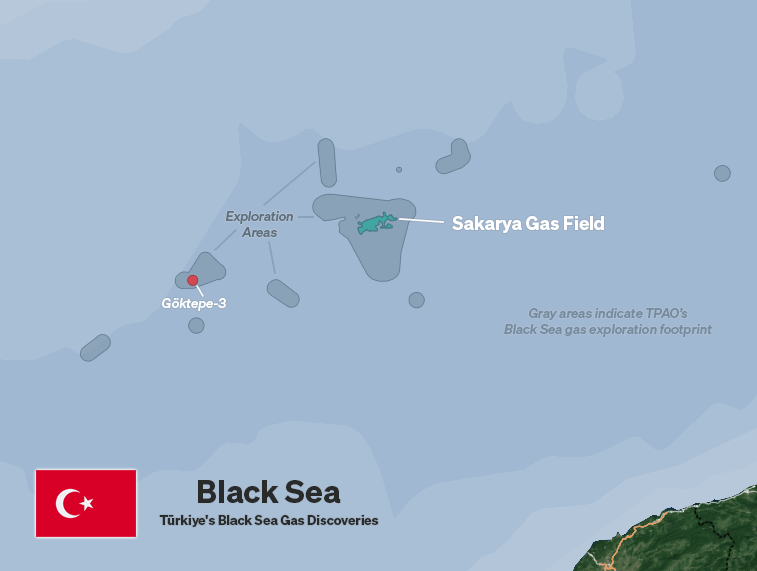
Turkey’s Sakarya began producing in 2023 and holds considerable growth potential as TPAO continues regional exploration, advancing Turkey's push for energy independence and the geopolitical gains it brings.
Turkey is likely done acquiring drillships, but India represents the next large energy-importing nation embarking on a critical offshore campaign. Having relied on sanctioned suppliers like Russia and Iran, India's exploration push could meaningfully cut import dependence and gain geopolitical currency.
India’s national oil company ONGC made news in early 2026 with a public tender for 3 drillships, 1 deepwater semisub, and 1 moored semisub on 5-year terms starting in 2027 tied to a goal of drilling 150 wells over 7 years, a pace unrealistic for deepwater.
In early June, ONGC pared the tender back to "one or more drillships," dropping the semisubs. Still, ONGC reportedly is in the market for 3D seismic work, a logical precursor to a real exploration campaign. ONGC isn't India's only source of rig demand, as Reliance Industries and Oil India are rig consumers as well. The original tender was always an extreme bull case, but the directional signal for drillship demand remains positive as it's driven by energy security needs, not shareholder demands for dividends and buybacks that constrain capital spending at the majors.
In a deepwater market suppressed by capital discipline, India has the potential to plug the gap the way Turkey did through its ~30 Tcf Sakarya discoveries in the Black Sea. NOCs move slower than majors, as the revised ONGC tender shows, so patience is required. But successful exploration could unlock considerable upside demand — less constrained by the capital discipline doctrine majors apply to fund dividends and buybacks, and instead rewarded by the geopolitical gains of energy independence.
Proposed Transocean-Valaris Merger
A key item to follow in the drillship market for the second half of 2026 will be if the proposed Transocean-Valaris merger receives regulatory approval. Transocean’s 2Q26 conference call is scheduled for August 5th, when a transaction update is anticipated.
In May 2026, Transocean and Valaris received a second request of information from the US Department of Justice. While the market viewed this negatively, the request was rational considering the size of the two companies and the impact of the proposed merger on deepwater contract drilling market structure.
I'm not an antitrust lawyer, but I took a high-level look at the merger through a Herfindahl-Hirschman Index (HHI) lens back in early May. My core view: competitive analysis here shouldn't be country-specific but instead should be global, since drillships are mobile assets that routinely relocate across basins. Recent examples: Asgard moved from the US Gulf to the East Med, West Carina moved from Brazil to Africa/SE Asia, and Santorini is scheduled to move from the East Med to Côte d'Ivoire. In the aforementioned TotalEnergies Venus tender for work in Namibia, there are rigs bid into the tender that are currently in Brazil, the US Gulf, SE Asia and the East Med. This is a global market.
While ~20 deepwater floaters currently work the US Gulf, at least 33 active rigs have operated there since 2019, and ~48 drillships globally (excluding semis) are capable of Gulf work, with another dozen (or more) eligible with some upgrades. Deepwater contract drilling therefore remains structurally competitive. Given the inherent operating leverage of these assets — idle costs run ~$40k/day and up to keep warm — drillers are strongly incentivized to bid warm rigs for work.
My first reactions to the Transocean-Valaris news: (1) positive for 7G dayrates, and (2) materially deleveraging for Transocean given the all-stock structure. Valaris has built a reputation for bidding low and reactivating cold rigs ahead of market readiness, suppressing dayrates in the process. The real value of the combination is not maximizing dayrates, it's removing a player that's effectively subsidized oil major returns by often accepting below-market returns on its assets. New drillships cost $750mm-$1B to build and need >$600k/day to earn their cost of capital; bids below $400k are a subsidy to oil majors on 7G drillships. An all-stock deal that exists partly to deleverage the acquirer to better enable the initiation of a dividend/repurchase program is not the fact pattern of an anticompetitive combination.
Qualitatively, the Transocean and Valaris fleets complement each other well with little specification overlap. Transocean holds two 8G drillships to Valaris' none; both have large 7G fleets, but Transocean's are mostly 1,400st hookload versus Valaris' 1,250st. Transocean also holds seven Norway-eligible harsh-environment semisubs to Valaris' none, while Valaris brings a large shallow-water jackup fleet Transocean lacks entirely. The key distinction: Transocean's Norway semisub fleet has underpinned recent earnings strength given that market's relative resilience, while Valaris carries greater West Africa 7G drillship exposure, a softer market through 2025 and into 1H 2026 that's driven more trailing white space and earnings pressure.
There's plenty to follow in this volatile industry — deepwater FIDs, the Brent futures curve, drillship utilization and dayrates all carry a wide range of potential outcomes. But near-term, the Transocean-Valaris merger is the one to watch most closely: next week's earnings call should bring a transaction update, and the bigger question is whether the deal still closes on schedule before year-end 2026.
A week ago I wrote a 43-ish-pager deep dive about Transocean myself- I will be honest: turns out I haven't dug deep myself. Especially on the field dynamics, FIDs & other shenanigans in practice as you did. Thanks, Tom! Always much appreciated! :) Keep going;
Noble's recent earnings were quite a thing I was waiting for; Now on to August 5th! Fingers crossed, haha
Tremendous work in a still largely overlooked industry. Invaluable, really. Captures where we are and what to look for going forward.