

Debt itself didn’t cause the offshore driller bankruptcy cycle of 2016-2021. Debt plus a newbuild wave delivering into a downturn did, and it was bad for years.
Today, a non-existent orderbook is a better macro backdrop to support modest levels of debt in an optimal capital structure for offshore drillers.
Ten years ago, it was hard not to be a huge bear on deepwater rigs. Not only did OPEC crash the market in Nov 2014, but a bloated newbuild orderbook took years of deliveries and supply rationalization to absorb. Meanwhile, E&Ps and IOCs favored short-cycle shale capex, and the Permian was about to add a few million bpd at lower costs than deepwater could match. It resulted in a wave of bankruptcies of deepwater drillers from 2016-2021, although Transocean and Odfjell never filed.
Today, deepwater barrels are far more cost-competitive, thanks to eliminated redundancies and simplified, standardized project designs. Additionally, as more FPSOs come online, deepwater capex increasingly shifts to lower-cost brownfield tiebacks that leverage existing infrastructure.
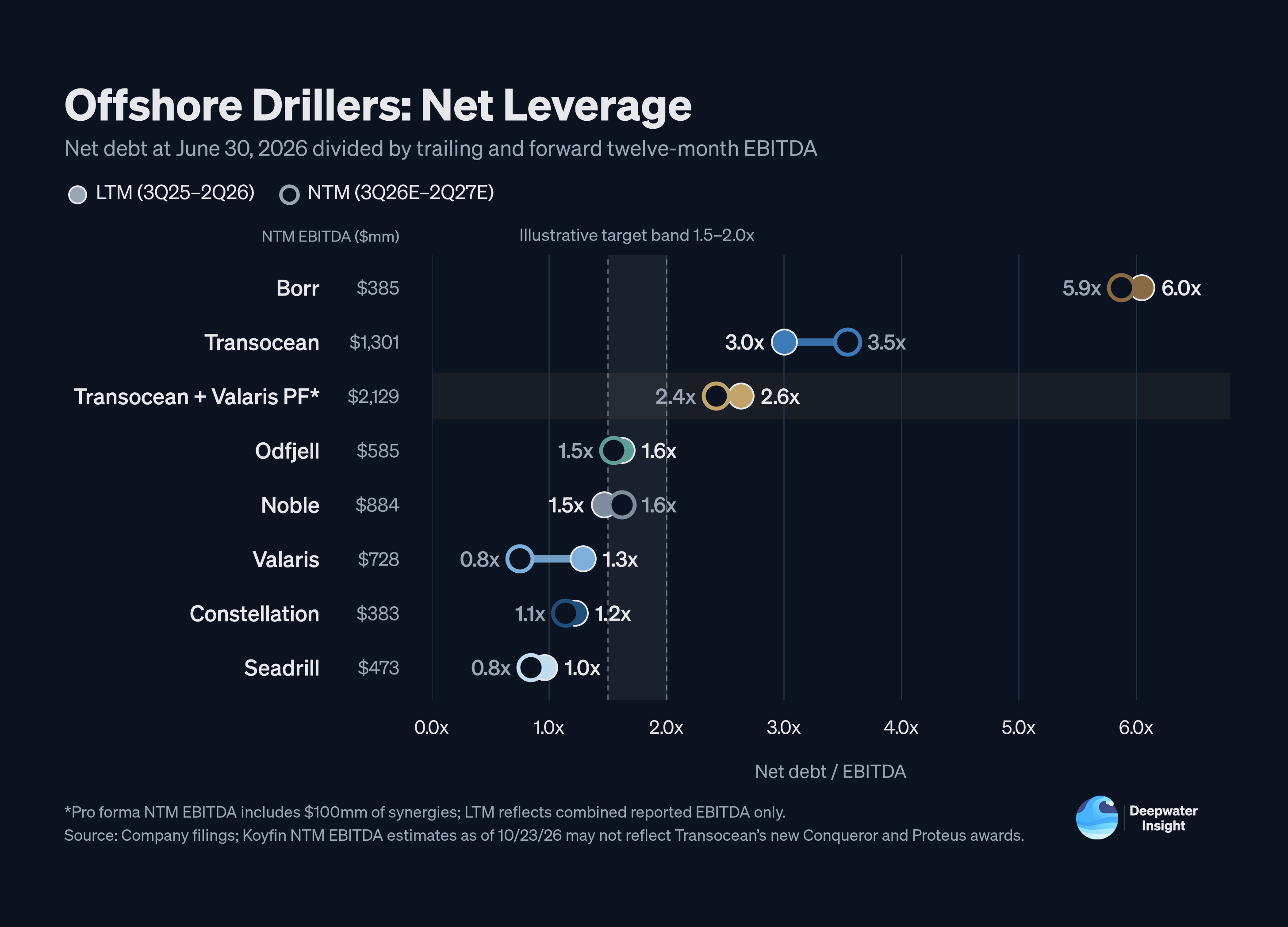
The proposed Transocean-Valaris merger has been cleared by all global regulatory bodies. A shareholder vote in November remains but should be a formality. Once the deal closes, the Transocean debate shifts from merger risk to potential shareholder returns and the combined company’s optimal capital structure.
Transocean has made substantial progress on the concerns I referenced in its capital structure in September 2025. Its secured bonds were, and remain, restrictive due to scheduled amortization and trapped balance sheet cash. Transocean has since repaid the Poseidon, Titan, and Aquila notes, with a clear path to retiring remaining secured debt in 1H 2027 if it chooses. Those notes absorbed as much as $400-$500mm of annual principal amortization, funded largely by contract backlog cash flows. Transocean’s deleveraging isn’t finished, but once the secured debt is gone, a portion of that cash can now more credibly be redirected to equity.
I believe Norwegian harsh environment semisub driller, Odfjell Drilling, sets an ideal example of balancing shareholder returns with an appropriate amount of leverage, which is currently ~1.6x net leverage and a >8% dividend yield. Once overleveraged, Odfjell deleveraged, then initiated a dividend with room to grow, and its stock has performed strongly in recent years. Transocean is unlikely to initiate a dividend at Odfjell’s current level of >8%, but Odfjell serves as a blueprint for a prospective shareholder returns program longer-term.
An offshore driller’s debt capacity depends on its size and fleet composition. Odfjell is a niche, harsh-environment player focused on Norway, but arguably has the best assets and reputation on the NCS. It’s only a 5-rig company but all assets are highly marketable at leading edge dayrates in a healthy rig market.
Transocean also has an NCS-eligible harsh environment fleet (currently 100% utilized), as well as an industry-leading drillship fleet and after combining with Valaris will also have a diversifying jackup fleet for shallow water markets. Given the combined Transocean-Valaris scale, fleet and regional diversification, and a stronger industry backdrop, Transocean should be able to comfortably sustain 1.5x-2.0x leverage while rewarding its shareholders. In my view, a mix of dividends, buybacks, and flexibility for potential single-rig acquisitions (if/when more accretive than repurchases at prevailing valuations) would create option value for the company and its shareholders.
Borr Drilling is a Different Credit Story
As a pure-play shallow-water jackup driller, Borr carries materially more leverage and greater exposure to the Middle East, where the Hormuz crisis is pressuring utilization and global jackup dayrates.
Borr’s trailing and forward net leverage of ~6x likely scares credit investors, but its liquidity is adequate because they recently pushed out their debt maturities to 2032 and 2034, and increased the size of their revolver to $250mm. Their jackup fleet is modern and capable of generating meaningfully more than current EBITDA levels of ~$385mm but the global jackup market is impacted by the Middle East, which generally accounts for ~35% of demand. Borr’s fleet is well-diversified geographically, but the Middle East region influences the jackup market as a whole.
The high yield credit market is saying Borr is overleveraged. Borr’s secured bonds trade actively in the USD high yield market, with the 8 ¾% 2032s and 9% 2034s both trading around 89-90, mid-600s OAS and ~11.5% yields. Borr is currently rated B/B3, but despite adequate liquidity, sustained net leverage near 6x may eventually lead the rating agencies to question the capital structure’s sustainability and potentially downgrade it to CCC+/Caa1. Current bond pricing arguably reflects much of that risk.
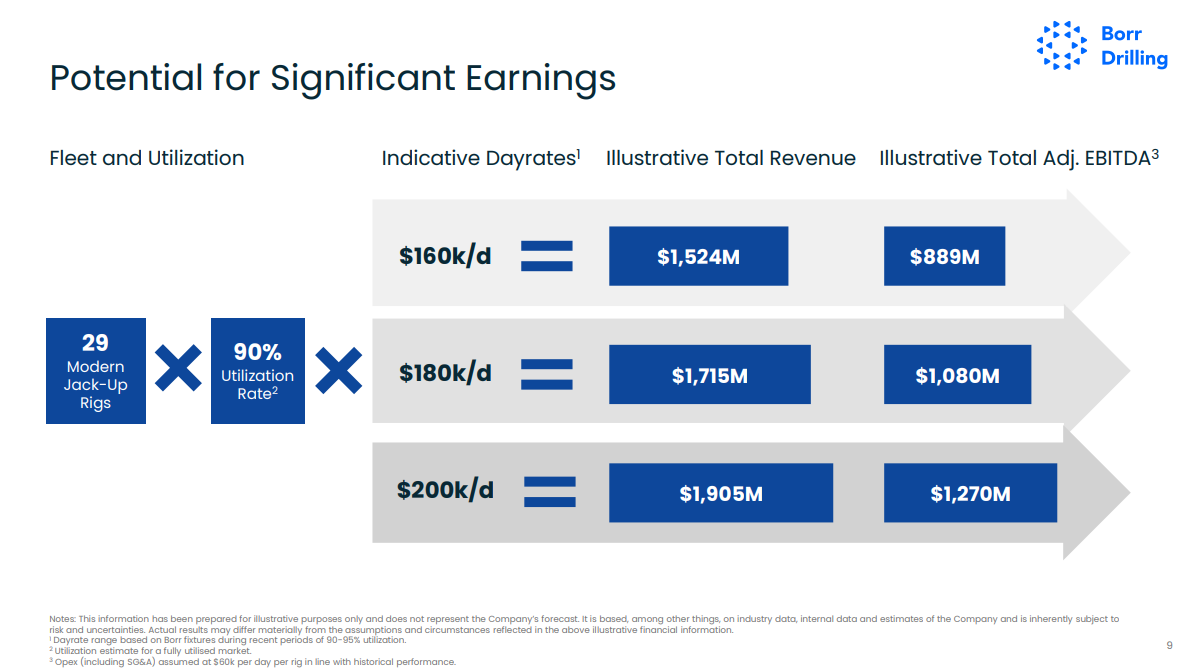
The bear case is that the $1,080mm EBITDA referenced in Borr’s slide above, which assumes 90% utilization at $180k dayrates and would bring net leverage to ~2x, arguably reflects the 2022-2023 market driven by Aramco’s capacity expansion. Absent a similar Middle East demand surge, those levels may not return. Borr currently generates ~$385mm, reflecting softer conditions.
The bull case is that Middle East demand is depressed because of the Hormuz crisis and if/whenever that normalizes, the region should rebound, lifting jackup utilization and dayrates, all else equal.
If Saudi Arabia and the UAE (now outside OPEC+) move to raise production after the Hormuz crisis, both could meaningfully move the jackup market, particularly Saudi. Aramco’s 2022 plan to expand capacity from 12mm to 13mm bpd swung nearly 10% of global jackup supply in both directions: tightening the market in 2022-2023, then loosening it when the program was shelved in 2024.
Summary
Moderate levels of debt are healthy for a large, diversified deepwater driller like the proposed Transocean-Valaris combination. The industry has a poor history with leverage, but the absence of newbuild orders points to a balanced market for the foreseeable future. A 1.5x-2.0x leverage target balances shareholder returns against a sustainable capital structure and a lower cost of capital.
Borr is currently overleveraged, as bond pricing suggests. A modest recovery in EBITDA should reduce leverage from ~6x to ~4x, although this is still an elevated level for an offshore driller. Achieving $1,080mm EBITDA (~2x leverage) will require Aramco to come back in a large way, which is speculative. With yields above 11%, I believe the secured bonds are attractive given Borr’s modern fleet. For risk-seeking investors, that leverage amplifies equity upside in a jackup rebound, and Borr has the liquidity to wait for one. The same leverage also magnifies downside in a dilution event.
Thanks for the write-up Currently, a long suffering holder of $BORR currently at breakeven. On the fence as to adding. Also, long suffering $RIG holder but that is finally paying off. Tor Troim has been buying like a drunken sailor. I can't help but think that is a positive sign.