

Offshore driller equities have traded with spot Brent crude oil in recent weeks, although their oil major customers base capital budgeting decisions on longer-dated futures, which better match the timing of their drilling programs. Intermediate-dated futures are better measures of their demand and have been more steady with 2028–30 Brent easing from $75–80/bbl two weeks ago to $71-74/bbl currently, still comfortably above the low-to-mid $60s that prevailed through 2H25 and early 2026.
Beyond softer crude pricing recently, Transocean, Noble and Seadrill all stated on their 3Q26 calls their oil major customers remain capital disciplined. That’s relevant mid-budgeting season, as a read-through to 2027 capex tempers hopes for much higher services spending, pointing instead to a more modest increase instead. Capital discipline has been a thorn in the side of offshore drillers for years, but the path forward is still constructive for deepwater project investment.
Capital budgets for 2027 are not yet final but E&P appears likely to take a larger share of spending at the expense of, for instance, renewable energy investments that were more popular in 2021-2024. Deepwater should benefit over the long term, considering its projects are large enough to matter to the majors and offer attractive and improving returns as costs reduce via simplification and standardization. In 2027, though, higher oil prices themselves won’t directly lift development drilling, which depends on specific sanctioned projects.
The Exploration Multiplier
The oil majors are sounding more constructive on exploration, an area where deepwater arguably offers more growth potential than other E&P sources given its frontier prospectivity. Exploration drilling tends to require shorter-term rig commitments and is not a major needle mover on rig utilization rates and dayrates beyond gap filler work, although successful exploration gradually leads to more drilling demand, and potentially can support new FPSO developments which build out deepwater infrastructure, and improve economics of future brownfield drilling demand via capital efficient subsea tiebacks. Given deepwater’s long-cycle nature, this does not happen overnight although oil majors would be wise to step up exploration in 2027-2028, since today’s discoveries create option value for capital-efficient reserve replacement and future dividend growth.
While oil majors are exhibiting levels of capital discipline, some mid-size, high yield issuing E&Ps have made positive announcements regarding oil discoveries last week, with Talos (B/B3) announcing constructive initial Daenerys appraisal results, after the summer of 2025 discovery, and Murphy Oil’s (BB/Ba2) promising Bubale results in Côte d’Ivoire.
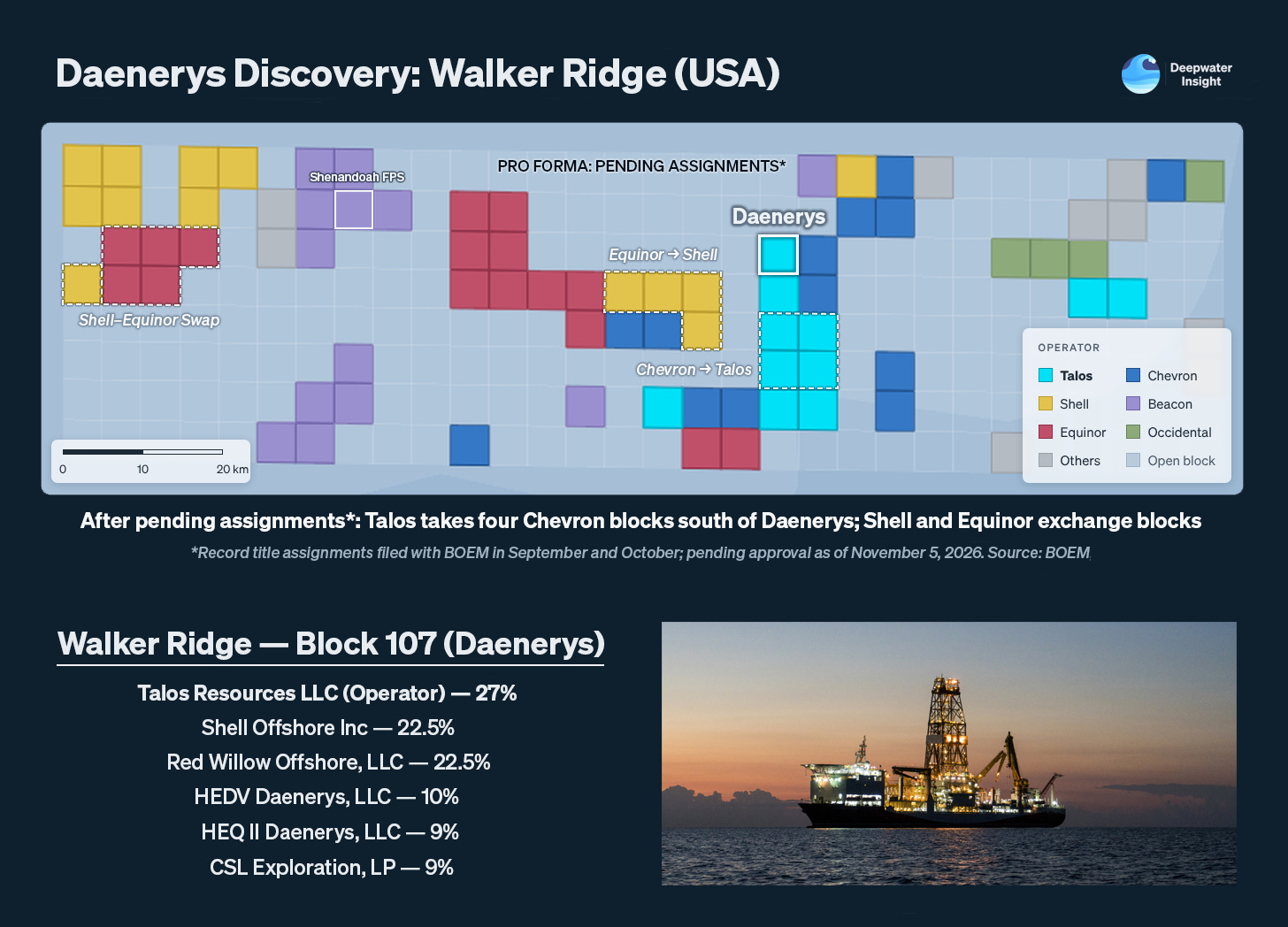
Talos — Daenerys: Testing the northern portion of the prospect “encountered oil pay in multiple sands”, although further tests are ongoing. Daenerys will be a “multiyear” appraisal program, with the next step being an appraisal sidetrack in 2027. While no declaration of commerciality has been made, further appraisal will help determine if Daenerys will be a potential subsea tieback or large enough to support its own hub.
Operator Talos plans to drill an exploration target in the southern part of the region in late 2027 or early 2028. Additionally, on October 27, BOEM received a request to assign Chevron’s leases on the four blocks between the Daenerys discovery to the north and Talos’ presumed southern exploration target. The assignment is pending approval.
On the topic of exploration, during the Q&A on its 3Q26 call, Shell mentioned Daenerys first among all its discoveries, despite only a 22.5% non-op interest. Separately, lease assignments between Shell and Equinor in Walker Ridge, still awaiting approval, would prospectively make Shell operator of four blocks west of the discovery (pictured), in exchange for blocks closer to Beacon’s Shenandoah (more on this later). If Talos’ upcoming appraisal and exploration wells suggest Daenerys can support a standalone hub, Shell would be a logical operator for the development. If not, Talos may remain the operator for prospective subsea tiebacks, if economics support the investment.
Murphy — Bubale: Murphy has completed a four-well exploration and appraisal program in Côte d’Ivoire with Transocean’s 7G drillship Deepwater Skyros. The first two wells, Civette and Caracal, were non-commercial, but Bubale was an oil discovery and Bubale West a successful appraisal. Analysis is ongoing, but Murphy said Bubale West increased its confidence that the Turonian can support an economic development (size tbd). It cited 88 net feet of oil pay, pressure continuity with the discovery well ~8 miles away, along with good permeability.
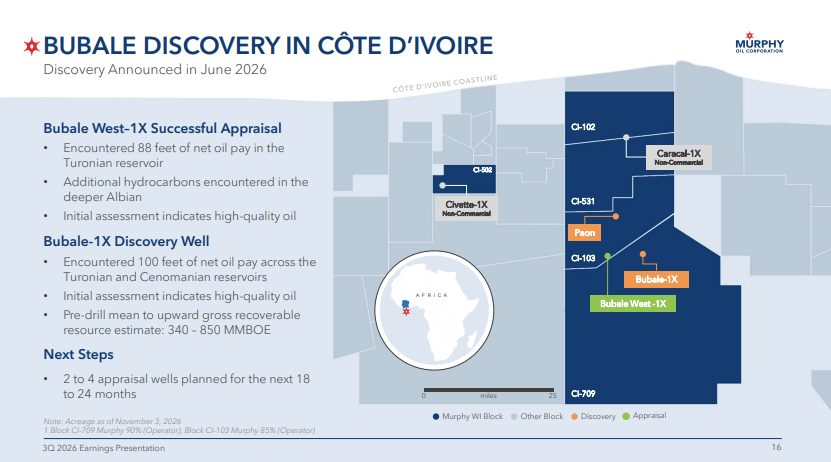
Murphy also found oil in the deeper Cenomanian and Albian, though it knows less about these reservoirs and both require appraisal. It plans another 2–4 wells over the next 18–24 months, possibly starting as soon as 2Q27. The DS-15 drillship is currently working in Côte d’Ivoire through May 2027 and would be a logical fit, although the current operator has options on the ship that may extend an additional 80-100 days.
Murphy has drawn criticism for being spread too thin geographically for a mid-sized E&P. Diversification supports the credit profile, but the lack of scale in any one region arguably limits the equity story. Côte d’Ivoire has potential to change that. Murphy holds 85–90% operator interests in its discoveries there, which could reasonably double its 3Q26 oil production (84k bopd) in the 2030s, even after a farm-down.
Murphy does not necessarily need a farm-down for a prospective Bubale development, although that depends on resource size. If needed, it could monetize its Eagle Ford, Tupper Montney, Gulf of America or Vietnam assets to raise funds for a prospective development. It could also add debt, although potentially at the cost of a credit downgrade from its current BB/Ba2 unsecured ratings. First, though, Murphy needs to appraise Bubale further. The faster it does, the sooner it can choose a development concept and funding path which should lead to better long-term decision making.
Azule Energy (recently upgraded to B1) joins Talos and Murphy as a mid-size E&P appraising potential deepwater developments, through its 42.5% non-operated interest in Namibia’s PEL 85 (Capricornus and Volans). The capex burden and execution risk of a deepwater development will concern debt investors, but could create opportunities for credit investors who follow these projects closely.
Offshore Services and Midstream - Transocean, Genesis, Seadrill and Borr
The US Gulf’s first 20k psi deepwater projects, Chevron’s Anchor and Beacon’s Shenandoah, have now produced for more than a year, with very different production trends thus far (pictured below). Both are key projects for Transocean’s 8G drillships: Deepwater Titan served as Anchor’s development rig and Deepwater Atlas as Shenandoah’s.
Beacon is a private E&P that is at least majority-owned by Blackstone. Shenandoah got off to a very strong start, with wells producing >20k bopd, and ownership was rumored to be exploring a sale. However, performance trends have weakened since impressive initial results. This has impacted midstream Genesis Energy (B+/B3) in 3Q26, as they cited “continuing challenges from two of the initial wells at Shenandoah,” which resulted in its supporting midstream infrastructure operating slightly below minimum volume commitments in 3Q.
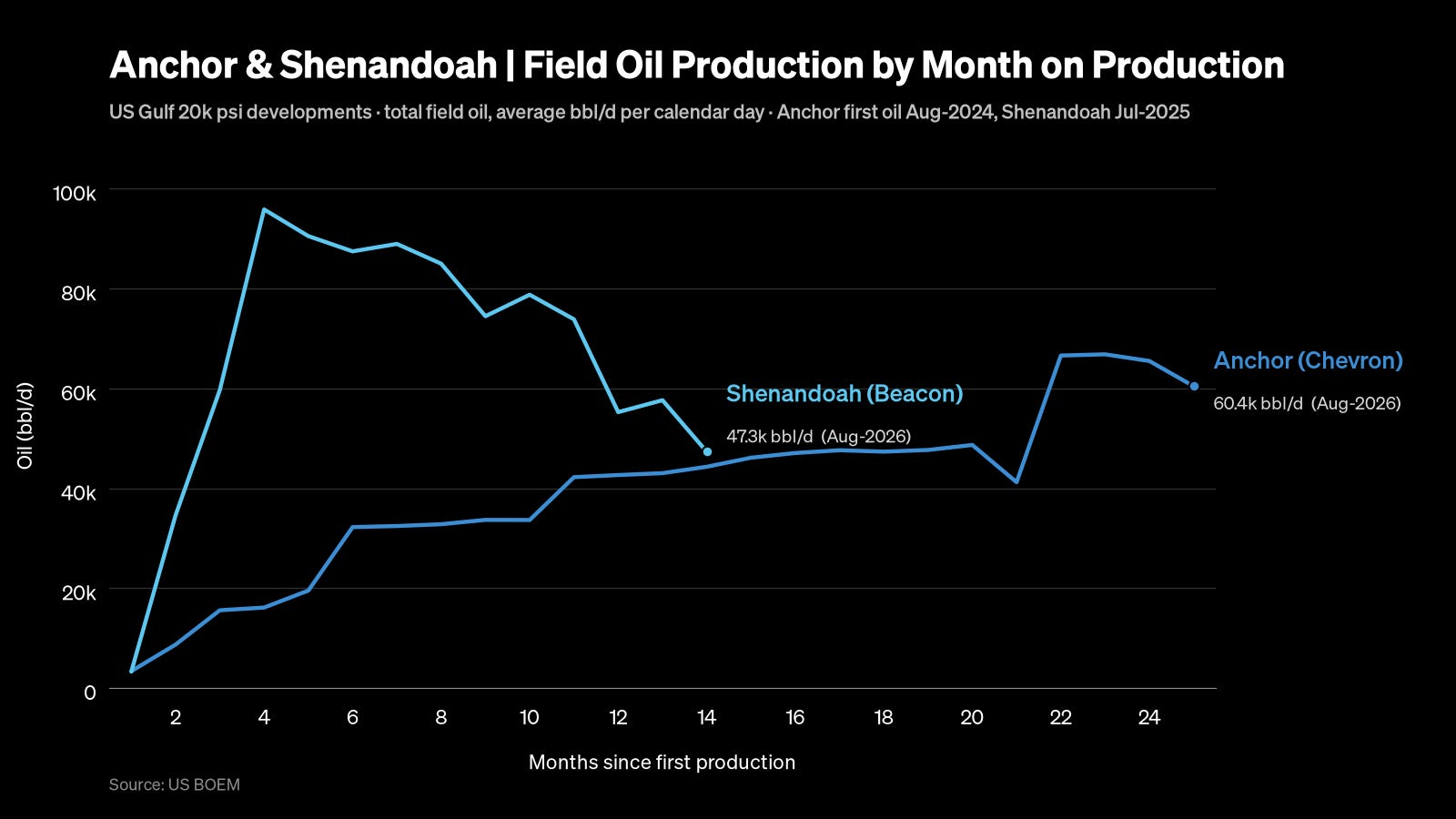
Production should improve as more wells come online. Specifically, two Monument wells (Talos ~29%, non-op) will be tied back to Shenandoah for production in early 2027, a subsea pump planned for 2028 should support output, as well as other potential wells. Shenandoah is running well below its ~120–140k bpd capacity. 8G Deepwater Atlas has an uncontracted window from September 2027 to June 2028, before two years of work with bp at $635k/day. That idle time is a risk for future earnings, though Shenandoah’s spare capacity may benefit from more drilling, as with other sources in GoA. Atlas is one of the highest specification drillships in the world with availability before it begins its campaign with bp for Kaskida and Tiber.
Seadrill’s new $420mm, 880-day contract in Indonesia with Eni+Petronas for 7G drillship West Carina had an interesting structural feature, an $85mm mobilization fee (with considerable margin to Seadrill) due in cash after invoicing at commencement of work, which accelerates cash collection of a meaningful portion of the contract. After former management printed some poor cash flow statements in 2023-2025, this is a welcome change and provides cash that can be used for repurchases, or potential other uses for shareholder value creation. However, the FCF improvement in 3Q26 appears to have benefited from positive working capital fluctuations, including extended payables, which will likely reverse next quarter.
One of the issues with Seadrill in prior years has been its substandard cash flow generation, which limited its ability to repurchase shares absent the aid from selling assets or spending down balance sheet cash. Seadrill’s new CEO is a former institutional investor and is appropriately focused on improving cash flow generation. Drillship contract releases usually give enough info to estimate dayrates, but they don’t show the timing of cash payments, which can vary by fixture. Quarterly consolidated cash flow is the only public proxy, and will be key for consistently rewarding shareholders via repurchases while maintaining credit quality.
Borr Bonds Facing Stress
Borr’s secured 8.75% 2032s and 9% 2034s are currently trading around 86-87 with estimated option-adjusted spreads in the mid-700’s and yields of ~12%. On October 24, Borr’s Prospector 5 jackup sank offshore Gabon while preparing for a drilling campaign. Four of the 115 on board died and one remains missing. Spreads have widened ~100 bps since. Borr likely carries insurance but has not yet disclosed details as its priority has been the safety and wellbeing of those impacted. Borr has engaged a classification society for an independent investigation of the incident. Its 3Q26 results are due on November 18th when more updates may be provided.
The global jackup market isn’t weak, but conditions differ by segment. Harsh-environment jackups in the North Sea have held up better than the benign market, including the Middle East, where working utilization has been impacted by regional conflict. Benign dayrates remain below 2023 levels, and strength varies by geography. Mexico illustrates the mixed picture. While Borr has extended Galar and Gersemi through May 2030, Hild remains uncontracted, and two of the five jackups in Borr’s 50%-owned JV are without work as of the 2Q26 conference call.
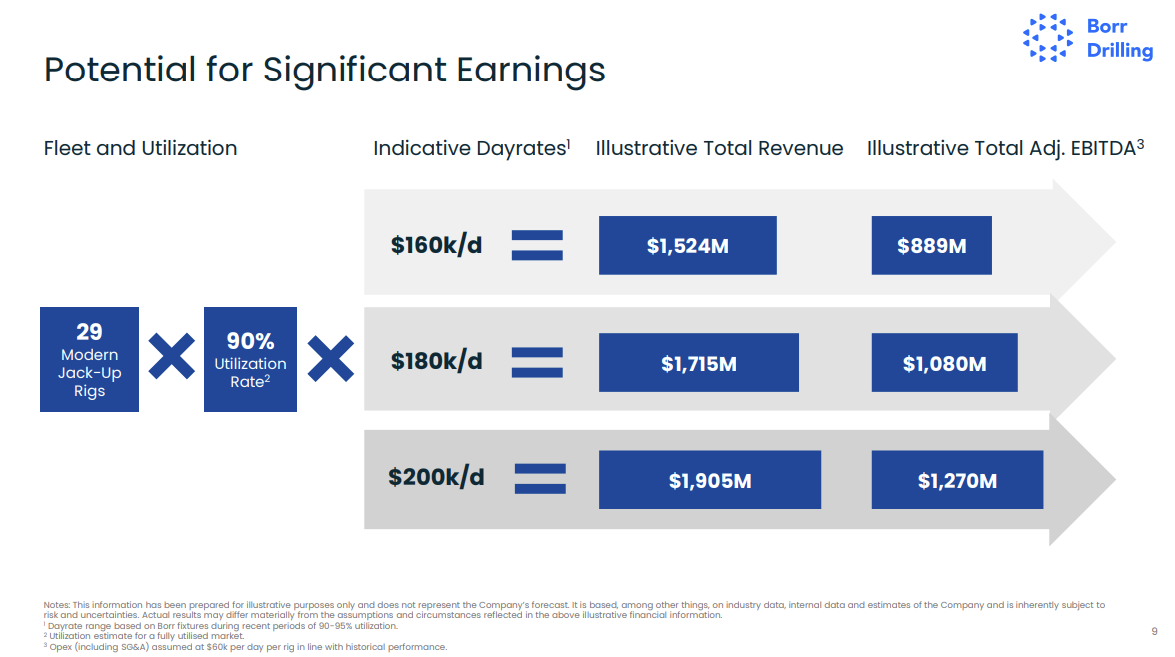
Borr’s modern jackup fleet has meaningful earnings potential, but the current market isn’t supportive enough to realize it, as shown by LTM EBITDA of $374mm and ~6x net leverage. Extrapolating the inferred linear relationship in the chart below implies annual EBITDA of $600–700mm at dayrates of $130–140k, roughly where Borr is booking new work, and 90% utilization. By comparison, Borr averaged 21.2 operating rigs out of 29 (73%) in 2Q26, at an average booked dayrate of $123k including older fixtures. This should improve, as the 2Q26 fleet status report shows 24 of 29 rigs (82.8%) contracted or committed, and since then Borr’s September 30th contracting update noted a new 60-day firm contract for previously idle Joro.
While jackup contracting is shorter cycle and can add utilization within months, Borr’s 2Q26 presentation points to 36% contract coverage in 2027 (including priced options). Since then, Borr has announced a 245-day extension for the Norve in West Africa, which will lift its 36% contract coverage for 2027, although Borr still needs higher utilization to support deleveraging.
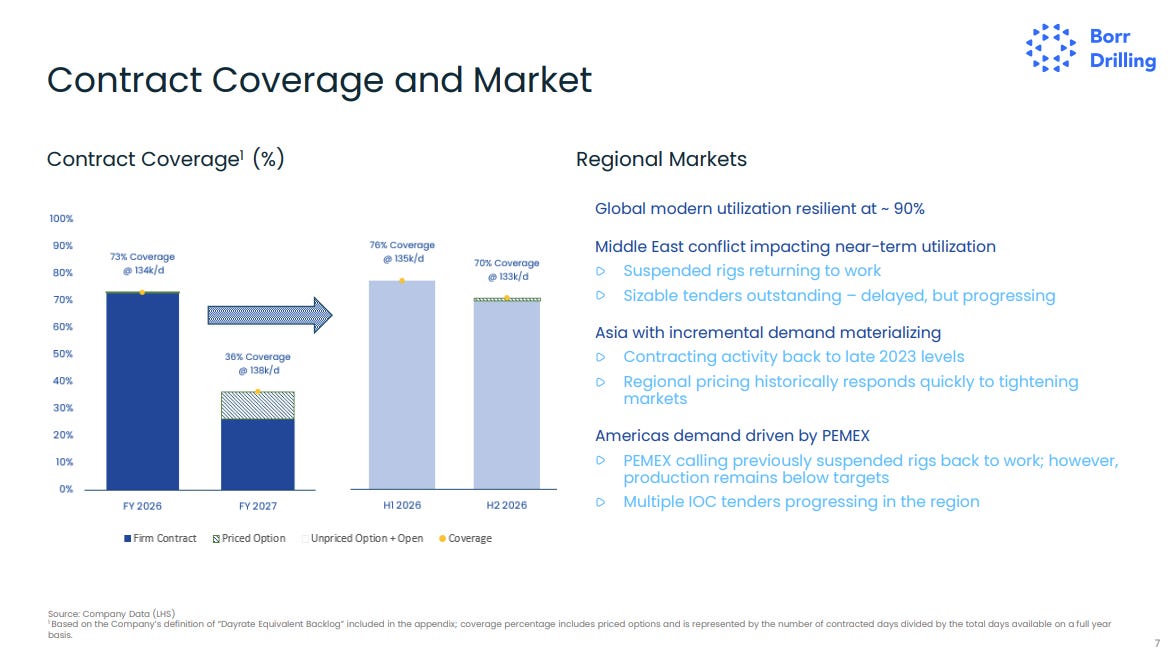
Prior to the Prospector 5 incident, Borr had adequate liquidity with no drawings under its $250mm super senior RCF. Additionally, its refinancing transaction in May 2026 pushed out its debt maturities until 2032 and 2034. While 2Q26 liquidity was adequate, Borr’s trailing leverage is elevated for an offshore driller. At ~6x trailing net leverage with uncertainties around Prospector 5, without improvement in utilization toward 90% (implied ~$600mm EBITDA at current rates and net leverage below 4x), questions regarding the sustainability of Borr’s current capital structure will become more prevalent. Contracting updates will be worth following in coming quarters, since Borr’s fleet has the earning potential to lift EBITDA meaningfully (and deleverage) if it secures more work.
Borr has a $250mm super senior RCF, and not all of its rigs secure the senior secured notes. Some recent acquisitions from Fontis and Noble were financed outside the bond collateral group using seller’s credits. As with any credit with spreads >600 bps, the strength of the indenture for credit investor protections becomes critical in the evaluation of the investment. Potential contingent liabilities from the Prospector 5 incident could become a draw on liquidity, though the amount is not yet known and may not be material. Beyond that, Borr faces no immediate need to address its capital structure despite elevated leverage given its liquidity is adequate, and the recent refinancing pushed its secured maturities out to 2032 and 2034, giving Borr time to wait for the market to improve and grow EBITDA into its capital structure.
Tommy you should look at TGS ASA as a beneficiary of increased exploration spending.