

The 7G drillship market is global, but the US Gulf, producing ~2 million bopd, accounts for roughly 25% of demand. In recent years Transocean has had around nine rigs in the region, Noble around six, and Valaris and Seadrill two each. While the US Gulf region has experienced weakness in the last 12-18 months, 7G drillship dayrates have appreciated due to strength in international markets, such as West Africa and SE Asia.
The following discussion is intended to spotlight activity in the US Gulf region, although deepwater is a global market, and as the dayrate chart below shows, is trending positively.
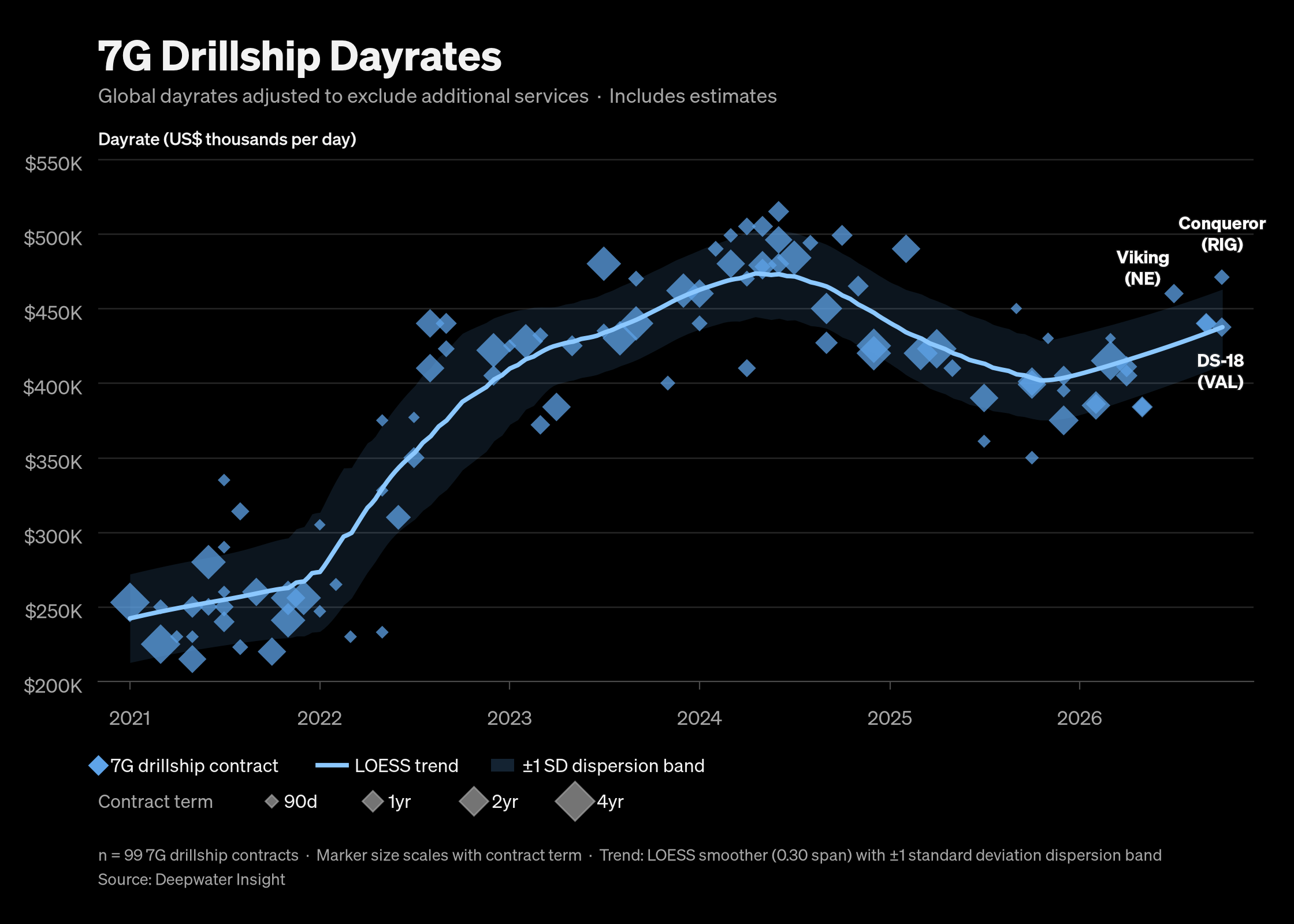
Two of the latest dayrate fixtures evidencing this trend are Transocean’s Deepwater Conqueror at ~$470k in Equatorial Guinea and Valaris’ DS-18 at a rumored ~$440k in Suriname. Both are 7G drillships that recently worked in the US Gulf before taking 6-7 month international contracts. DS-18 will then return to the US Gulf on a 914-day contract for Occidental, after completing exploration drilling for Petronas in Suriname.
The US Gulf and Mexico region floater count has fallen by 4-5 rigs over the last eighteen months, leaving some units idle and pushing others out of the region. Transocean’s Deepwater Asgard and Deepwater Conqueror have relocated to the Eastern Mediterranean and Equatorial Guinea, respectively, while Noble’s BlackRhino left for Nigeria after sitting idle since May 2026. Note that some of the reduction in rig count is due to the attrition of the region’s less efficient rigs leaving the global fleet.
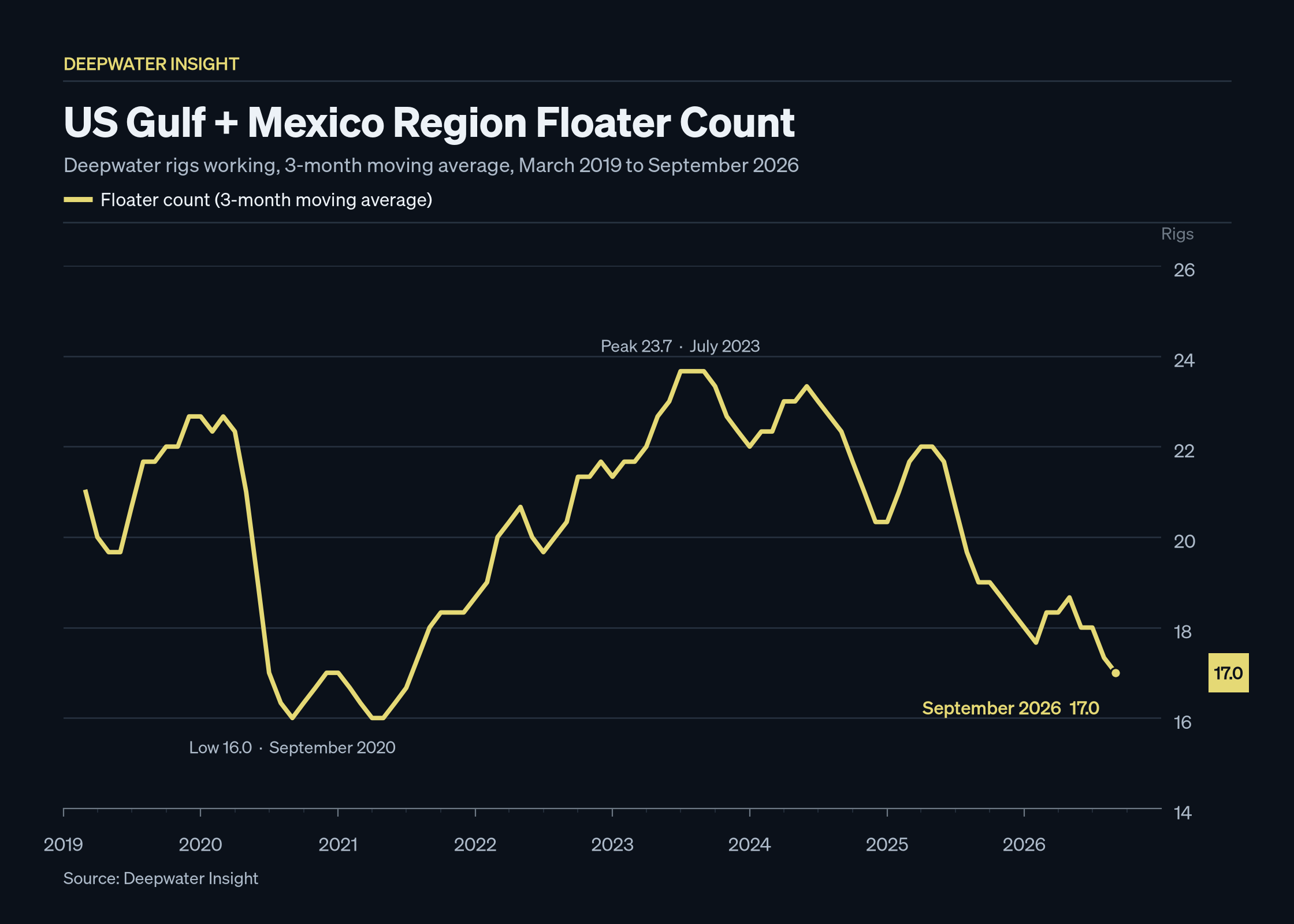
Deepwater E&P focuses on large fields, so drillship demand can be lumpy and regional swings common. US Gulf rig demand has softened recently and should stabilize and may gradually recover into 2028, though it is unlikely to return to the 22-24 rig counts seen in 2023-2024. Several factors likely explain the lower US Gulf rig count:
Chevron’s acquisition of Hess, which closed in 2025, led to one fewer rig demanded. Chevron acquired Hess for its 30% non-op interest in Guyana’s Stabroek Block, and not for its US Gulf E&P business which had mediocre performance but often consumed one drillship. That Hess-related demand is now absent, though may return in smaller bunches in the future for infrastructure-led capex at fields such as Stampede and Tubular Bells.
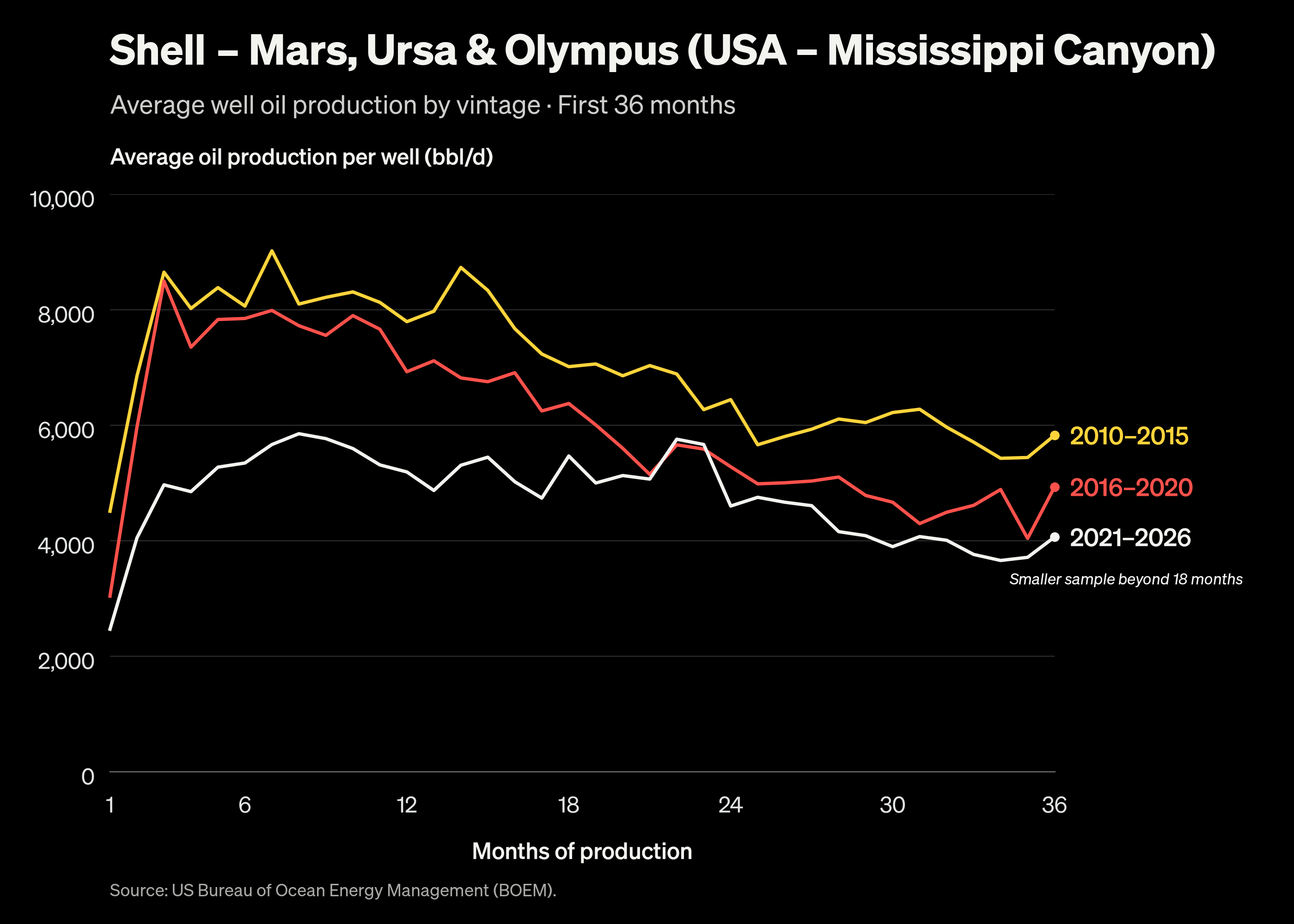
Shell-operated Mars-Ursa-Olympus (“Mars”) is the largest complex in the US Gulf, producing ~215k bopd in July 2026. Mars, a medium sour grade, traded at a meaningful premium to Brent at the onset of the Iran war, leading me to argue that Shell should consider contracting another 7G drillship for brownfield capex at Mars. On closer review, however, new well productivity at the Mars complex has been weakening (see below) and may play a role in Shell running one fewer rig today than the 5-6 it used in prior years.
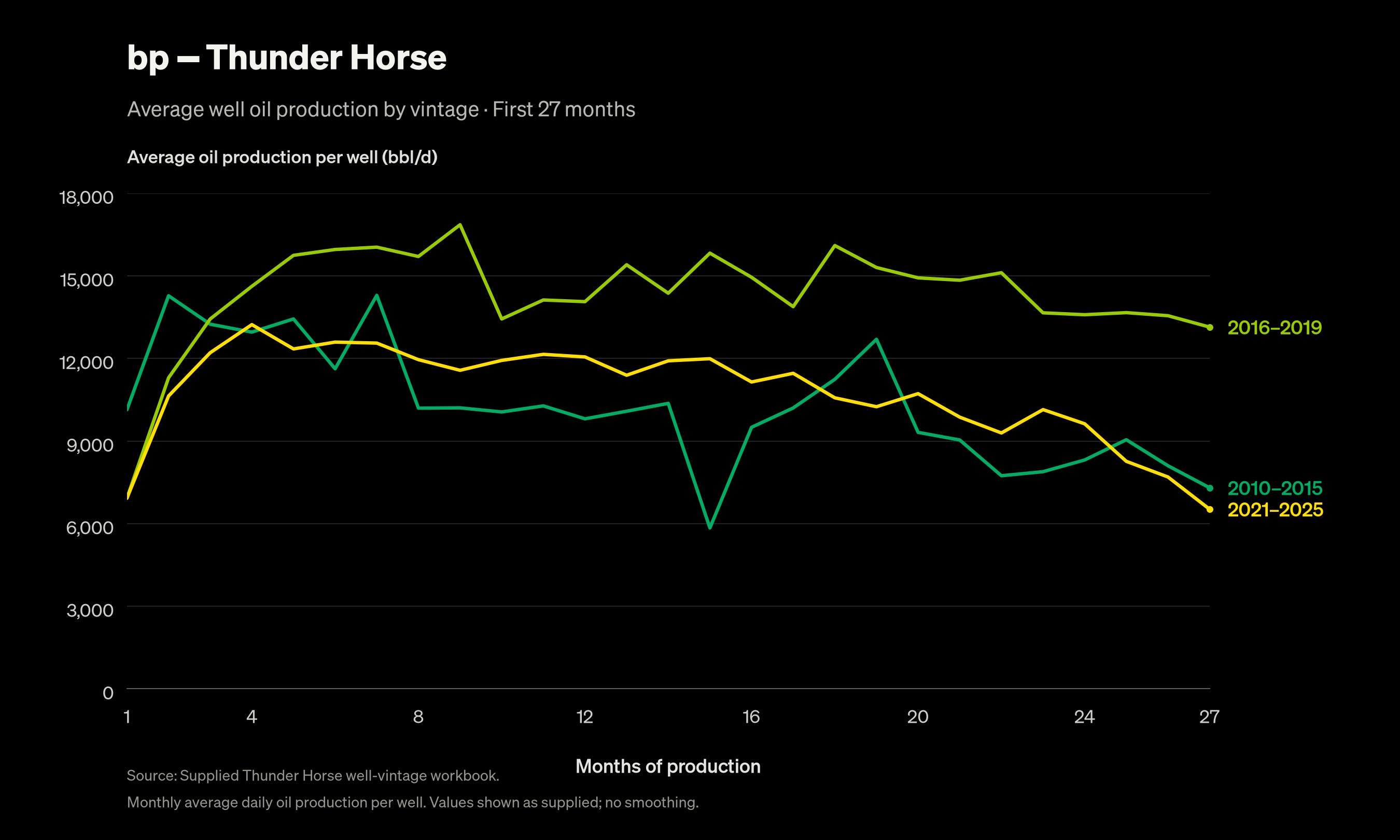
bp began drilling Kaskida, its 80k bopd, 20k psi project, in 1H26, with first oil expected in 2029. bp still has 100% of Kaskida and carries its full capex. The deferred farm-down was the primary driver behind bp raising its capex guidance on 2Q26 earnings. Kaskida projects as highly economic, so if I were bp I’d be fine keeping 100%, although I suspect the higher capex burden is also eating into its US Gulf E&P budget and deferring other capex in the US Gulf (e.g. adding another drillship). bp’s other US Gulf E&P assets are performing well, including Thunder Horse (pictured).
Under the prior US administration, there were multiple lease sale pauses and delays, as well as environmental delays due to concerns on items like the Rice’s whale. It’s typical for the US to hold two lease sales per year, and from 2021-2024 only three lease sales were held. Despite good existing infrastructure, the US Gulf remains at least a medium-cycle capex region, and the policy uncertainty of prior years, which made planning ahead difficult, may be weighing on current activity. However, recent policy has been supportive, with a consistent lease sale schedule and royalties on new deepwater leases cut from 18.75% to 12.5%.
Rig efficiency explains some of the reduction, but it’s unclear how much. The US Gulf has added three new, high specification drilling rigs (Titan, Atlas and Evolution) in recent years, all while effectively disposing of former US Gulf rigs 6G Discoverer Inspiration (scrapped), semisub DPS-5 (scrapped), 6G Globetrotter II (held for sale) and 6G Globetrotter I (marketed internationally, at risk of scrapping). Upgrades such as managed pressure drilling (MPD) on part of the existing fleet have also improved efficiency.
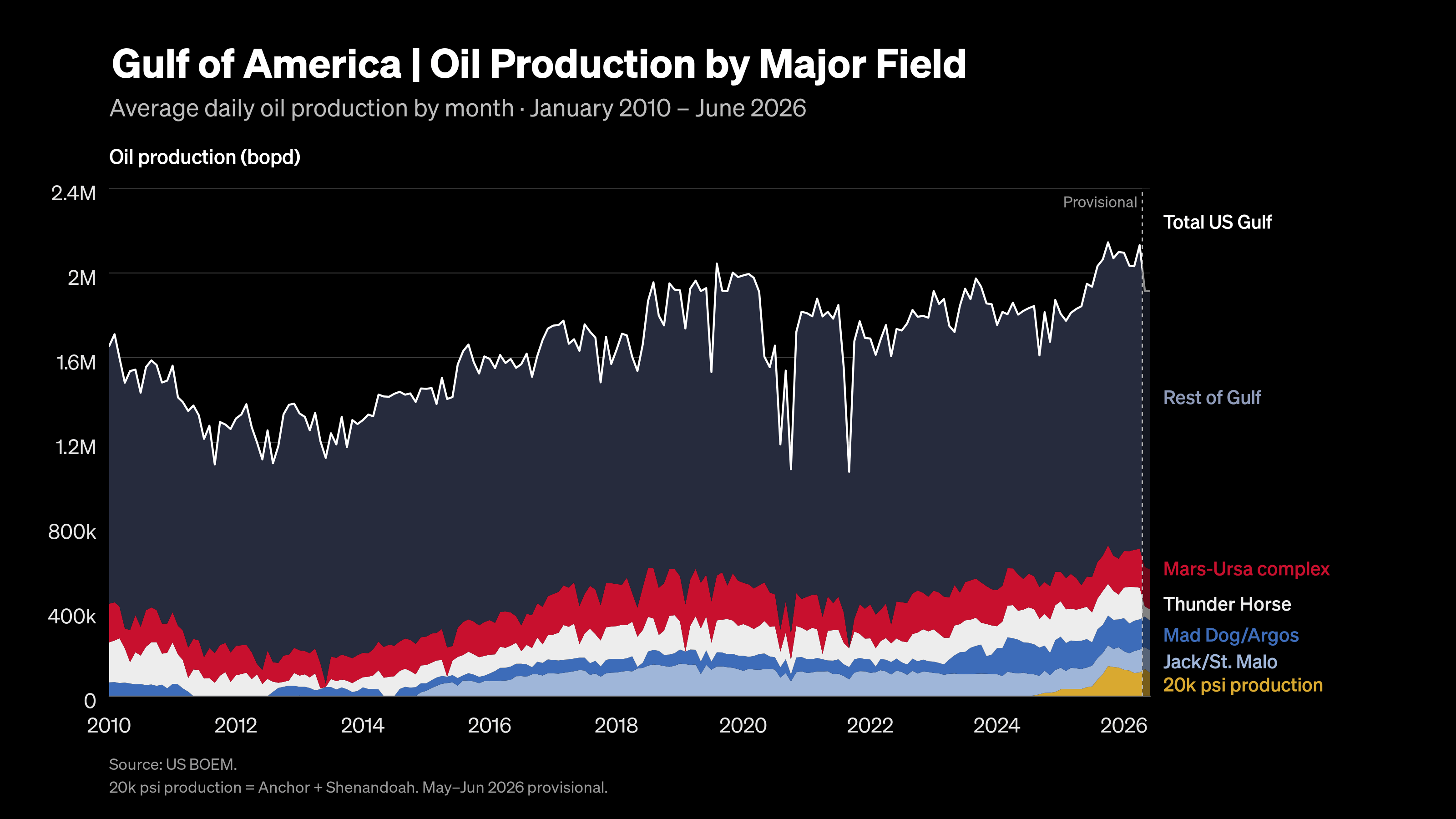
Rig activity tends to lead US Gulf oil production, so recent rising output alongside a falling rig count shouldn’t be mistaken for an improvement in rig efficiency. Instead, the recent drop in rigs points to lower US Gulf production into 2027.
What does this mean for the drillship market?
While the US Gulf has experienced production increases in recent years, it is generally a mature production region. The region tends to have higher well costs than other international markets, although it benefits from an existing infrastructure system that supports more stable brownfield capex. The region remains important for oil majors such as Shell, bp and Chevron, among others.
Rig demand in deepwater is lumpy, and after 12-18 months of softness I expect some demand to return eventually, though not to the 22-24 rigs of 2023-2024. Mars’ productivity has weakened, but Shell has nearly three decades of field data since first oil in 1996. Advances in data processing and analysis could lift productivity on new wells there and support other infrastructure-led projects across the US Gulf. Other mature regions are already moving this way, including Norway’s large E&Ps and TotalEnergies in Angola.
The US Gulf has leading technology, evidenced by the recent success of 20k psi projects Anchor (Chevron) and Shenandoah (Beacon). Shell/Equinor’s Sparta is expected to reach first oil in 2028, followed by bp’s Kaskida in 2029 and Tiber in 2030. Recent lease sale activity indicates a pipeline of future 20k projects, potentially from new operators, which is positive for 8G drillships. Despite this technology advancement, most of the region’s production will likely still come from conventional deepwater developments.
The Mexican side of the Gulf has its first deepwater project scheduled to produce first oil in 2028, Woodside’s Trion with 100k bopd capacity. Potential exists for further exploration and development in Mexico, although Pemex has been moving slowly. Petrobras signed a strategic cooperation agreement with Pemex in June 2026, a promising development for the region, though it is still in its early stages and Petrobras is building other international options outside Brazil.
The proposed Transocean-Valaris merger cleared US antitrust review on September 30, 2026, a clear positive for the global drillship market. A consistent lease schedule and lower royalties on new deepwater leases should also support future E&P capex, all else equal. Harbour’s acquisition of LLOG and its hiring of a second drillship are early evidence of this.
Tommy, would like your thoughts on Northern Ocean’s Mira contract to Shell in Trinidad and then share offering & debt restructuring. If Shell exercises the 1Y option, seems like NOL is in a much more comfortable position into 2028 and beyond, despite the immediate share price hit.